

Foggy glass replacement usually costs $150 to 600 per pane, but size, grids, Low-E coatings, and access can push totals well past $1,000.
Clear Answers for Cloudy Windows
That hazy, grey film between your panes isn’t dirt — it’s a failed seal letting moisture in for good. The glass itself can usually be replaced without tearing out the whole window frame. Our window glass replacement team measures, quotes, and installs sealed units built to your exact opening. Get a free quote and see your real number today.
Most homeowners calling about foggy glass have already gotten at least one quote that surprised them — either because it came in lower than expected and they’re suspicious of the catch, or because it came in hundreds of dollars higher than a neighbor’s job on what looked like an identical window. The difference almost always comes down to what’s actually being measured, sourced, and installed, not whether one company is “better” than another.
We measure the opening, not the label on the box
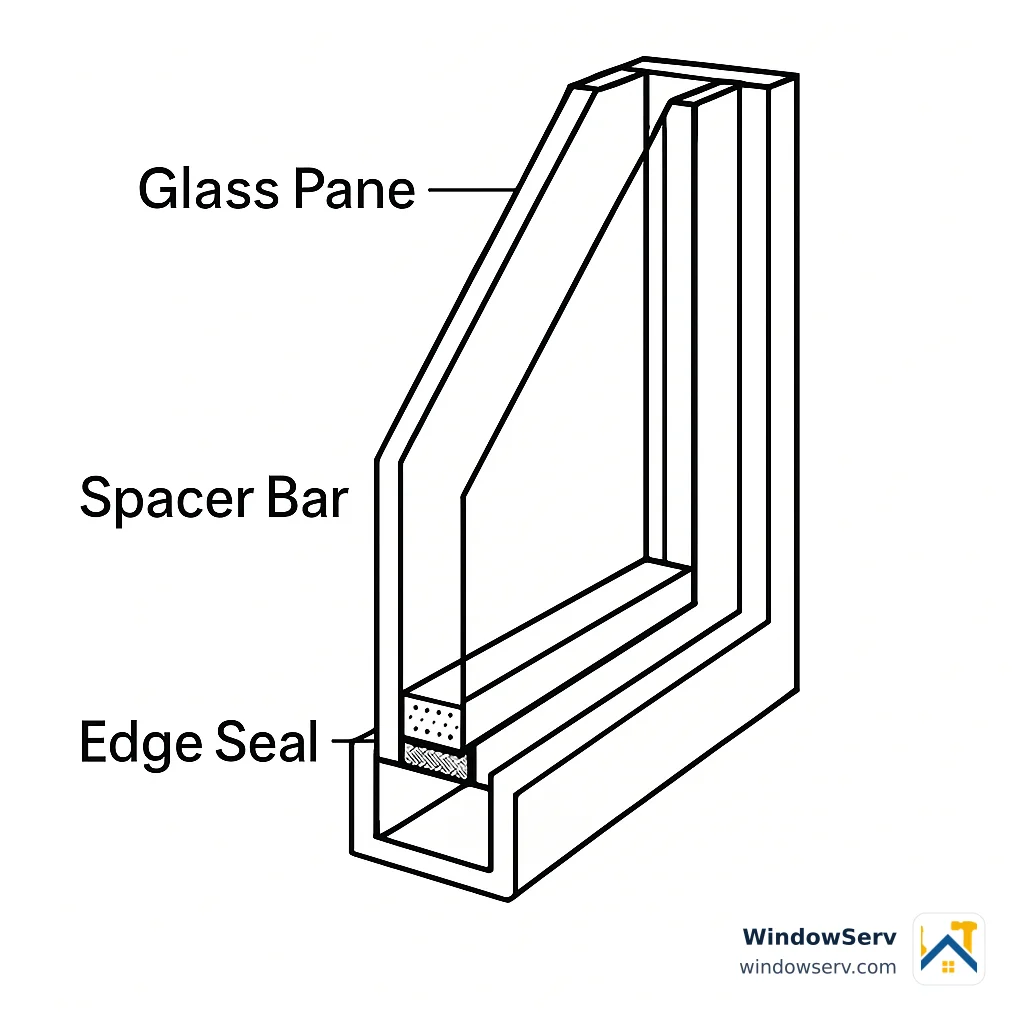
Sealed glass units are built to order. A window that looks like a standard 3-foot-by-5-foot double-hung can have a rough opening that’s off by a quarter inch in either direction, and an IGU that doesn’t fit tight against the spacer bar will fail again within a few years. Our techs take field measurements on-site rather than quoting off a builder’s spec sheet, which is why our written estimate matches what you pay at install — we don’t come back later with a “the opening was nonstandard” surcharge.
Our quotes separate glass cost from labor cost
A lot of confusion in this industry comes from lump-sum quotes that bundle glass, labor, disposal, and a markup into one number with no breakdown. We itemize the sealed unit cost, the grid or muntin pattern if your window has one, any Low-E or argon upgrade, and the labor and access charge separately. That means if you want to skip the argon fill to save money, you can see exactly what that saves — not just trust us that it does.
We stock common sizes and glass packages
For standard residential sizes in clear dual-pane and basic Low-E configurations, we keep glass on hand or can turn an order around in two to four business days through our regional glass fabricator network. Custom shapes, true divided-light grids, and triple-pane or specialty tempered glass typically run one to two weeks. We tell you which category your window falls into at the quote stage, not after you’ve already scheduled a day off work for the install.
Technicians who know failure modes, not just installation
Replacing the glass is only half the job. If the original seal failed because of a warped sash, rotted wood frame, or a spacer bar issue from a manufacturing defect, swapping in new glass without addressing that will just fog again in a few years. Our techs are trained to flag those underlying issues at the quote visit, which is one of the most common gaps we see when homeowners compare our estimate against a lower one from a glass-only outfit that didn’t inspect the frame. We cover this exact gap in more detail in our guide to common glass replacement mistakes, including the frame issues that cause repeat fogging.
Warranty that covers the seal, not just the glass
Our sealed units carry a manufacturer warranty against seal failure, and our installation labor is separately warrantied for one year. If a unit fogs again within the warranty window due to a seal defect, we replace the glass at no charge — you’re not paying labor twice because of a manufacturing issue that wasn’t your fault or ours.
Transparent access and disposal pricing
Second-story windows, bay and bow configurations, and windows behind shrubs or AC units take longer to access safely, and that time shows up on the invoice as a line item, not folded invisibly into a higher “per window” rate. Old glass and failed seals are hazardous to handle and require proper disposal, which we include in every quote rather than charging it as a surprise add-on at the end of the job.
Local crews, not subcontracted labor
Jobs are completed by employees on our payroll, not a rotating pool of subcontractors paid per job regardless of quality. That consistency is part of why repeat customers call us for every window in a multi-pane fogging situation rather than shopping each one separately.
Short answer
foggy glass means the sealed unit’s edge seal has failed, letting moisture between the panes — the glass (not the whole window) can usually be replaced.
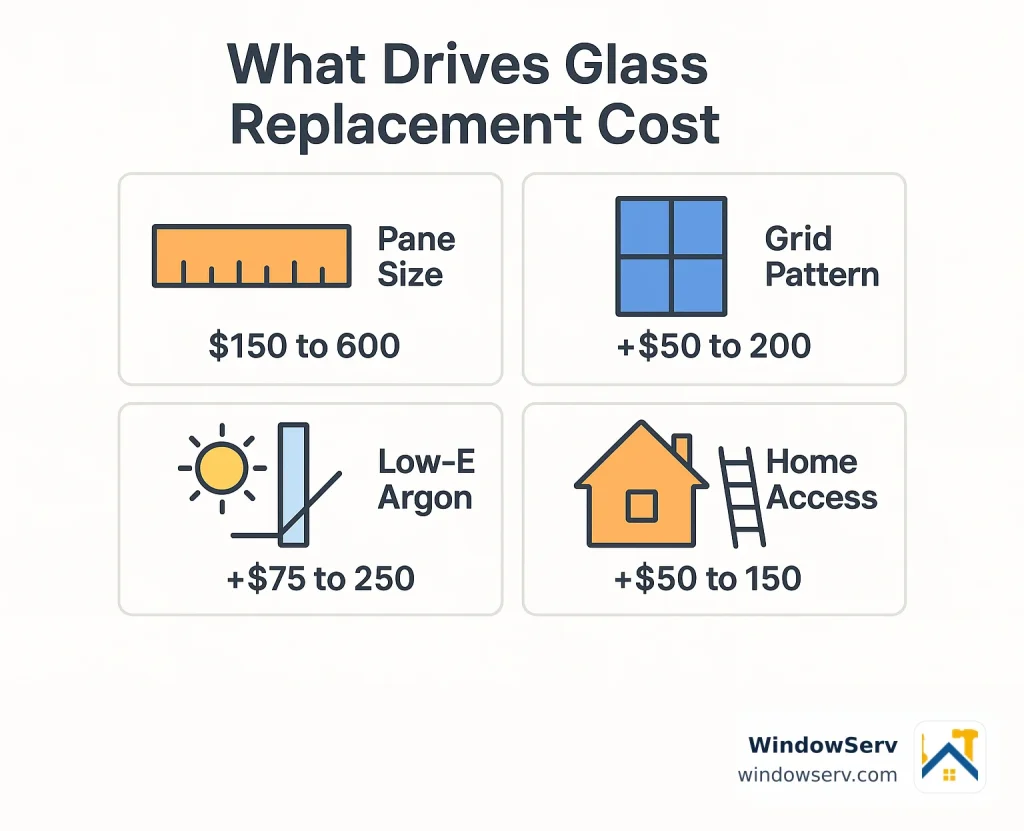
- Typical cost per pane: $150 to $600 for standard clear glass
- With grids or muntins: add $50 to $200 per pane
- Low-E or argon upgrade: add $75 to $250 per pane
- Hard-to-access windows: add $50 to $150 per window
- Turnaround: 2 to 4 business days for standard sizes; 1 to 2 weeks for custom
This article was reviewed by Mark Delaney, Lead Glazing Technician at WindowServ, who has spent over fourteen years replacing and repairing residential window glass across the region. Mark trains new technicians on seal failure diagnosis, IGU measurement, and glass handling safety, and personally inspects any job flagged as a warranty callback. He holds glazing certifications through the National Glass Association and regularly consults with fabricators on sizing and seal technology for older, discontinued window lines. His focus in reviewing this piece was making sure the cost breakdown reflects real line items on a real invoice, not rounded estimates.
Two quotes for what looks like the exact same foggy window can land hundreds of dollars apart, and almost none of that gap is random. It comes from four variables stacking on top of each other: how big the glass is, whether it has a grid pattern baked into the unit, whether it includes a Low-E coating or argon gas fill, and how hard the window is to physically reach. Below is a realistic breakdown of how those variables move the price on a single standard residential pane.
| Scope | Typical Price Range | What Drives It |
|---|---|---|
| Small pane, clear glass, easy access | $150 to $250 | Smallest standard sizes (e.g. bathroom or basement windows) with no grid, no coating |
| Standard pane, clear glass, ground floor | $200 to $350 | Most common double-hung or slider replacement size |
| Standard pane with grid or muntins | $275 to $500 | Grid pattern is built into the sealed unit itself, not applied after |
| Standard pane with Low-E coating | $300 to $500 | Coating reduces UV and heat transfer, priced per square foot |
| Standard pane with Low-E and argon fill | $375 to $600 | Argon improves insulation value further, requires a gas-filled seal process |
| Large pane (picture window or patio slider) | $400 to $900 | Larger glass costs more per unit and is heavier to handle safely |
| Second-story or hard-to-access window | add $50 to $150 | Ladder work, scaffolding, or extra labor time |
| Custom shape or discontinued sash profile | $500 to $1,200+ | Glass must be fabricated to a nonstandard template |
Why pane size moves the price first
Glass is priced per square foot before anything else gets added. A small bathroom window and a large picture window with the same grid pattern and coating can differ by $300 or more purely because of surface area. This is also why a quote for “one broken window” can look very different depending on which window in the house it actually is.
Why window grids raise glass replacement costs
A common point of confusion is assuming grids are a cosmetic grille snapped onto plain glass. On most modern sealed units, the grid pattern is either sandwiched between the panes or adhered to the surface as part of the manufactured unit, which means it has to be built to spec rather than added after the fact. That manufacturing step is what adds the $50 to $200 premium, not the grid material itself.
Low-E and argon are optional, but not interchangeable
Low-E coating is a microscopically thin metallic layer that reduces heat transfer and UV exposure, and it’s priced on its own. Argon gas fill is a separate upgrade that replaces the air between the panes with a denser, more insulating gas, and it typically requires a slightly different seal process to keep the gas from escaping over time. Quotes that combine both will cost more than either alone, but homeowners in moderate climates sometimes skip argon and keep only the Low-E coating to control cost without losing much practical benefit.
Access charges are about safety, not inconvenience
A second-story window over a sloped roof or a window behind a deck railing takes longer to access safely and may require two technicians instead of one. That labor time is a legitimate cost driver, and a quote that doesn’t account for it on a hard-to-reach window is either underbidding the job or planning to add the charge later as a surprise.
Why two quotes for the same window can differ by hundreds
If one quote is itemized by pane size, grid, coating, and access, and the other is a single flat number, you’re not comparing the same scope. The flat-rate quote may be excluding the grid rebuild, assuming ground-floor access when the window is actually second-story, or using a lower-grade glass than the itemized competitor. Always ask for the breakdown before comparing two numbers side by side.
Foggy glass is one of the more tempting window problems to try fixing yourself, mostly because the window itself isn’t broken — it still opens, closes, and locks normally. But “the glass fogged, not the frame” is exactly why this job is more specialized than it looks, and why most DIY attempts end up costing more in the long run than hiring it out the first time.
What you can reasonably do yourself
You can diagnose the problem yourself with confidence. If the fog or film appears only between the panes and never wipes away from either the inside or outside surface, that’s a failed seal, not dirty glass, and no amount of cleaning will fix it. You can also measure the rough opening yourself to get a rough sense of sizing before calling for quotes, and you can research whether your window brand is still manufacturing replacement-compatible units, which affects both cost and turnaround time.
What gets genuinely difficult fast
Removing the old sash or glazing without cracking the frame requires knowing exactly how your specific window style — casement, double-hung, slider, or picture window — holds its glass in place, and that varies significantly by manufacturer and by the window’s age. Ordering the replacement IGU yourself means getting the measurements, the spacer bar depth, and the glass thickness exactly right, since even a small error means the unit won’t seat properly against the seal channel. Handling the glass itself is also a real safety consideration; sealed units are heavier and more awkward than single-pane glass, and a dropped or cracked unit mid-install is a lost $200 to $600 with nothing to show for it.
| Factor | DIY | Professional |
|---|---|---|
| Diagnosing fog vs. dirty glass | Easy, low risk | Not needed |
| Measuring rough opening | Doable with care | Field-verified, matched to seal channel |
| Ordering correct IGU | Risk of sizing or spec errors | Ordered to exact field measurements |
| Removing old sash glazing | Moderate to high risk of frame damage | Routine for trained techs |
| Handling and setting new glass | Physically awkward, injury risk | Standard safety equipment and technique |
| Warranty if it fails again | None, unless glass supplier covers it | Labor and seal typically warrantied |
| Realistic cost if done right | $150 to $400 in materials, your time | $150 to $900 depending on pane, fully warrantied |
When DIY makes sense
If you have a small, standard-sized window with a simple sash design, no grid pattern, and you’re comfortable with basic glazing tools, a single pane replacement is within reach for a patient homeowner. This is most realistic on older wood-frame windows with traditional putty glazing, where the process is more forgiving than modern vinyl or composite frames with snap-in glazing beads.
When to call a professional instead
Vinyl and composite-frame windows, anything with a grid pattern or Low-E/argon upgrade, second-story or hard-to-access windows, and any window where the frame itself shows warping, rot, or water staining around the glass all belong with a professional. That last point matters most: if the frame caused the seal to fail in the first place, replacing just the glass without addressing the frame means you’ll be back here again in a few years. For a closer look at where homeowners commonly go wrong attempting this themselves, see our breakdown of beginner glass replacement mistakes, which covers several of these exact failure points in detail.
A reasonable middle ground
If you want to save money without the full DIY risk, do the diagnosis and measurement yourself, get an itemized professional quote based on your numbers, and ask directly whether the frame needs any attention before the new glass goes in. That conversation alone will tell you a lot about whether the contractor you’re talking to is being thorough or just quoting glass.
Hiring out a glass replacement is usually the right call, but not every company that answers the phone for “window repair” has the right setup to do glass work well. A few specific questions at the quote stage will tell you more than any review site.
Ask about licensing and insurance directly
Requirements vary by state and municipality, but reputable glazing contractors carry general liability insurance at minimum, and many jurisdictions require a contractor’s license for work that touches the structure of a window frame, not just the glass. Ask for the license number and insurance certificate up front rather than taking a verbal “yes, we’re licensed” at face value. A contractor confident in their standing will produce this without hesitation.
Get the quote itemized before you agree to anything
As covered in the cost breakdown above, pane size, grid pattern, coating upgrades, and access all move the price independently. A legitimate quote should list these separately, not as one bundled number. If a contractor resists breaking down the quote or gets vague when you ask what’s included, treat that as a signal to get a second opinion before scheduling.
Ask what happens if the frame has hidden damage
A technician who only quotes the glass without inspecting the sash and frame is setting you up for a repeat failure. Ask directly: “If you find rot or warping in the frame once the old glass is out, what happens to the price and timeline?” A contractor with a clear, specific answer to that question has likely dealt with it before. One who seems surprised by the question probably hasn’t looked closely at frames before quoting glass jobs.
Seek glass-specific references instead of handyman ones
A company might have excellent reviews for gutter cleaning or general repairs but limited actual experience with sealed glass units, which have their own failure modes and handling requirements. Ask for references or photos specifically from glass replacement jobs, ideally ones similar in age or window type to yours.
Confirm the warranty terms in writing
Ask specifically whether the warranty covers the sealed unit against future seal failure, the labor and installation separately, or both, and get the duration of each in writing on the invoice or contract. A quote that mentions warranty verbally but doesn’t put it on paper isn’t a quote you can enforce later if the glass fogs again in two years.
Compare timelines honestly
Standard sizes in common configurations should be achievable in a few business days to about two weeks; if every company you call quotes a month or more for a standard window, that may signal a sourcing issue worth asking about directly, since unusually long timelines sometimes mean a contractor is routing your order through a slower secondary supplier.
For a more detailed walkthrough of exactly what to ask and what red flags to watch for before signing a contract, our contractor screening checklist for foggy window repair goes through the vetting process question by question. Taking twenty minutes to run through that list before committing to a contractor is a small investment next to the cost of redoing a botched glass replacement.
What a solid quote visit looks like in practice
A technician should measure the opening on-site rather than relying on assumed standard sizes, physically inspect the sash and surrounding frame for rot or warping, ask what climate and sun exposure the window faces to recommend (or rule out) Low-E and argon upgrades, and leave you with a written, itemized quote rather than a verbal number. If a company is willing to do all of that before you’ve committed to anything, that’s a strong sign they’ll handle the actual installation with the same level of care.
Tired of looking through fog instead of your view? Our glass specialists can measure your window, confirm whether it’s a glass-only fix or needs a full sash replacement, and send a written quote within one visit. No obligation, no pressure — just a clear number for a clear window. Request your free glass replacement quote and get a technician scheduled this week.