
Why a Broken Window Balance Turns Into a Bigger Problem Fast Double hung window balance repair is something most New Jersey homeowners will need to deal with at some point
Why a Broken Window Balance Turns Into a Bigger Problem Fast
Double hung window balance repair is something most New Jersey homeowners will need to deal with at some point — especially in older homes where windows work hard through hot summers and freezing winters.
Here’s a quick answer to get you started:
How to repair a double hung window balance:
-
Identify your balance type — spiral, block and tackle, constant force, or cord and weight
-
Remove the window sash by disengaging the tilt pins or take-out clips
-
Inspect the balance for broken cords, worn springs, or a slipped balance shoe
-
Replace the faulty balance with a matching unit (measure length, diameter, and weight capacity)
-
Reinstall the sash and test the window at multiple positions
-
Adjust tension if the sash still slides or feels stiff
Think about what a window balance actually does. It counteracts the weight of the sash — that heavy pane of glass — so you can push it up and it stays there. Without it, gravity wins every time.
When a balance fails, the sash drops on its own. That’s not just annoying. It’s a safety hazard, especially for kids or pets nearby. It also means your window isn’t sealing properly, letting conditioned air escape and pushing your energy bills higher.
The good news? Balance repairs are one of the most affordable window fixes you can make. Balance shoes run just $5 to $10 at most hardware stores, and many repairs take less than an hour with basic tools.
This guide walks you through everything — from identifying your balance type to replacing it correctly.
Understanding Your Window Balance System
To fix a window, we first have to understand the “quiet hero” hidden inside the frame. If you’ve ever wondered why a heavy glass sash feels light as a feather when you slide it up, you can thank the balance system. Whether you live in a historic home in Montclair or a modern townhouse in Jersey City, your double-hung windows rely on these mechanisms to fight gravity.

The Role of the Window Balance
The primary job of a window balance is to provide mechanical tension. This tension matches the weight of the window sash (the movable part of the window). When the balance is working correctly, it allows for smooth operation and precise sash positioning. You should be able to lift the window halfway and have it stay exactly where you put it.
If the balance loses tension or breaks, the sash becomes “dead weight.” This often leads to the window slamming shut unexpectedly or being nearly impossible to lift. In many cases, a simple Window Repair can restore this functionality without needing to replace the entire frame. If the internal components are shot, a more specific Window Balance Replacement and Repair is the most cost-effective path forward.
Common Types of Balance Mechanisms
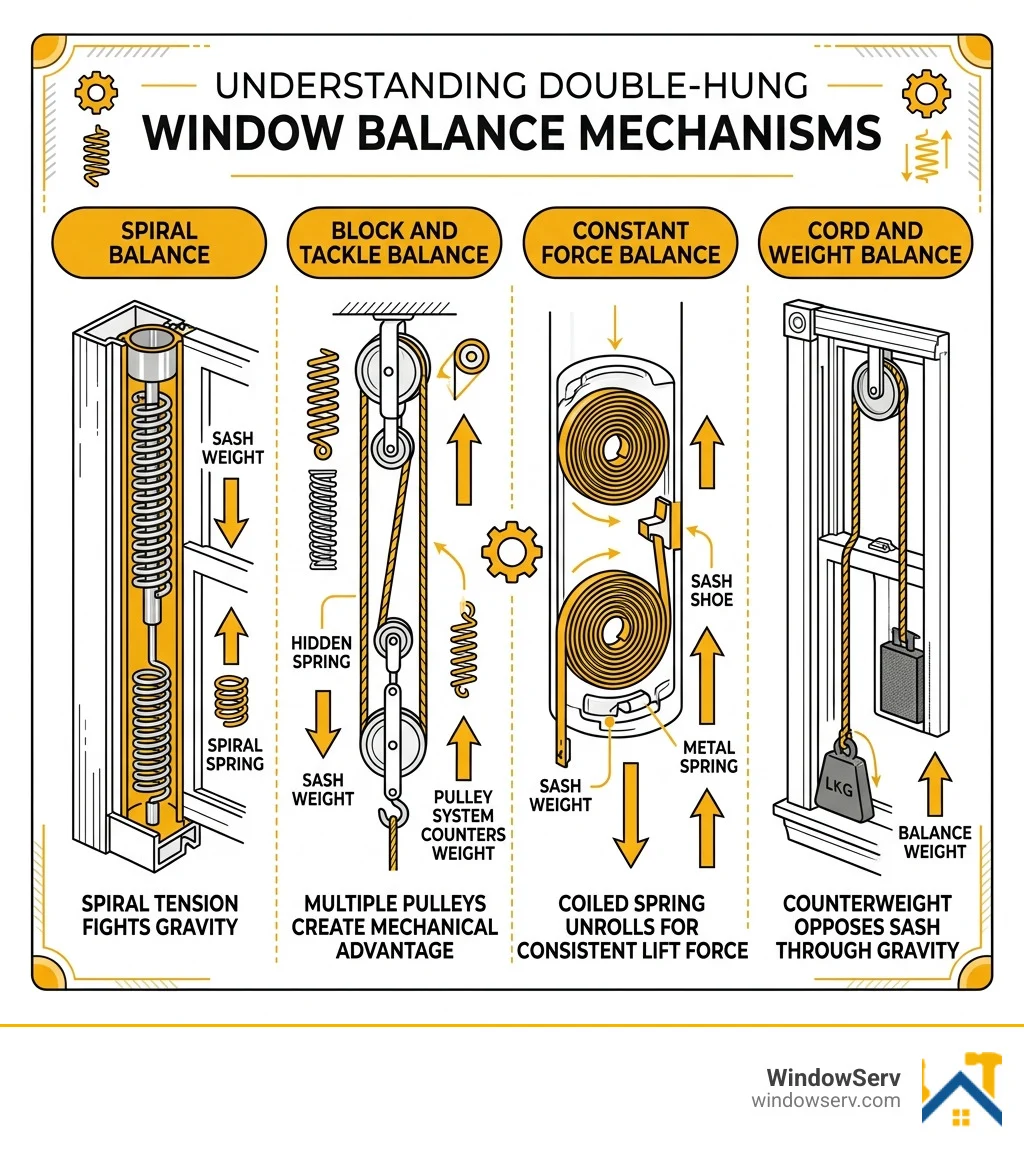
Before you start ordering parts, you need to know which system you have. Over the decades, window technology has evolved significantly. Here is a breakdown of the four most common systems:
Balance Type Era / Popularity How it Works Common Failure Point Cord and Weight Pre-1950s Lead or iron weights hang on ropes over a pulley. Frayed or snapped cotton cords. Spiral Balance 1960s-1980s A spiral rod inside a tube uses a tensioned spring. Spring loses tension or rod bends. Block and Tackle Modern / Popular A system of pulleys and a cord connected to a spring. Snapped strings or broken plastic pulleys. Constant Force Modern / High-End A stainless steel coil spring that unrolls like a tape measure. Debris buildup or rusted coils.
If your window uses a spring-based system, you may specifically need a Window Spring Replacement to get things moving again.
Signs You Need Double Hung Window Balance Repair
How do you know it’s time to stop propping your window open with a stick? The signs are usually pretty obvious, but some are more subtle than a window slamming shut.
-
The “Guillotine” Effect: The most dramatic sign. You open the window, let go, and it crashes down.
-
Sticking or Resistance: If you feel like you’re doing a heavy deadlift just to get some fresh air, the balance isn’t helping you anymore.
-
Unusual Noises: Grinding, popping, or clicking sounds inside the jamb often mean a spring has snapped or a pulley is jammed.
-
Uneven Movement: If one side of the window sits higher than the other, one of your two balances (there is one on each side) has likely failed.
-
Visible Damage: If you see a loose string dangling or a metal rod poking out from the side, that’s a “call to action” for a repair.
If your window is simply acting “fussy” but isn’t broken, a quick Window Adjustment might be all that’s required to realign the sash. If you are troubleshooting the issue yourself, you can find guides on how to repair a double-hung window that won’t stay up to help identify the problem.
Identifying Your Double Hung Window Balance Repair Parts
To perform a successful double hung window balance repair, identification is half the battle.
-
Tilt-in vs. Non-Tilt: Modern windows usually “tilt in” for cleaning. These use pivot shoes and pins. Older windows are “non-tilt” and often require removing the window stops (the wood or plastic trim) to access the balances.
-
Jamb Liners: In many vinyl windows, the balance is hidden inside a plastic “jamb liner” that runs up the side of the frame.
-
Part Numbers: Look for stamped numbers on the metal channel or tube. These numbers tell you the length and the weight capacity (tension) required for your specific sash.
If the sash itself is cracked or the wood is rotting along the bottom rail, you might be looking at a Window Sash Replacement rather than just a balance fix.
Safety and Energy Efficiency Risks
Leaving a broken balance unfixed is risky. A falling sash can break glass, pinch fingers, or cause serious injury. Furthermore, if a sash doesn’t stay tightly closed at the top, it creates a gap. In New Jersey, where we deal with high humidity and cold winters, these gaps lead to drafty rooms and sky-high utility bills. Maintaining Energy Efficient Windows starts with ensuring they actually close and lock properly.
Step-by-Step Double Hung Window Balance Repair Process
Ready to get your hands dirty? Most homeowners can handle this with a few basic tools: a flathead screwdriver, pliers, safety glasses, and work gloves.
Safely Removing and Reinstalling the Window Sash
For most modern tilt-in windows, follow these steps:
-
Unlock the window and raise the lower sash about 3-4 inches.
-
Engage the tilt latches (usually located on the top of the sash) and pull the top of the window toward you until it’s horizontal.
-
Lift one side higher than the other at a 45-degree angle. This disengages the “pivot pins” from the “pivot shoes” in the track.
-
Set the sash aside safely on a flat surface or a drop cloth.
If you have an older wood window, you may need to unscrew the window stops or use “take-out clips” located near the top of the track. For historic homes in places like Ridgewood or Tenafly, this process is often part of a larger Window Restoration project to preserve the original architecture.
Replacing the Balance Assembly
Once the sash is out, you can see the balances.
-
Block and Tackle: These are usually held in by a single screw or a hook at the top. Unscrew it, unhook the cord from the sash or shoe, and swap in the new one.
-
Spiral Balances: You’ll need a specialized “tensioning tool” to wind the internal spring. Be careful—these are under high tension!
-
Constant Force: These often come in “clusters.” You’ll need to pop out the detent clips, unscrew the mounting bracket, and slide the new coil into the shoe.
Always replace both balances at the same time. If one has failed, the other is usually right behind it. After installation, perform a calibration test by moving the sash up and down. It should move with equal effort in both directions. If it’s still stubborn, you might need professional Window Repair to diagnose deeper track issues.
Troubleshooting and Maintaining Your Windows
Even after a successful double hung window balance repair, maintenance is key to making sure you don’t have to do it again next year.
-
Track Cleaning: Dirt and pet hair are the enemies of window balances. Vacuum your tracks once a month.
-
Lubrication: Use a dry silicone-based lubricant on the tracks. Never use WD-40 or oil-based products, as they attract gunk and can actually gum up the mechanism.
-
Annual Inspection: Every spring, check your windows for frayed cords or rust. Catching a problem early is much cheaper than waiting for the “guillotine” to drop.
For a full list of ways to keep your home’s glass in top shape, check out our comprehensive Window Services.
When to Choose Window Replacement Over Repair
We love saving windows, but sometimes they are past the point of no return.
-
Wood Rot: If the frame is soft or crumbling, a new balance won’t help. You likely need Window Wood Rot Repair or a full replacement.
-
Foggy Glass: If you see moisture between the panes, the seal has failed.
-
Structural Damage: If the house has shifted and the window frame is no longer “square,” the balances will never work correctly.
In these cases, a Window Replacement is the smarter long-term investment for your home’s value and comfort.
Professional vs. DIY Repair Costs
DIY repair is very affordable. You’re looking at $20–$50 for parts and a Saturday afternoon of your time. However, hiring a pro has its perks. A specialist diagnosis costs around $100, and a professional repair usually ranges from $175 to $600 depending on the complexity.
Pros bring the right tools (like spiral tensioners) and have access to hard-to-find parts for older brands. Plus, we can spot hidden issues like Window Wood Rot Repair that a homeowner might miss.
Frequently Asked Questions about Window Balances
How much does it cost to repair a double-hung window balance?
On average, a professional double hung window balance repair costs between $150 and $250 per window. If the frame is in bad shape, you might also need Rotten Window Frame Repair, which can add to the cost. DIY parts are cheap ($5–$30), but the labor and expertise are where the value lies in professional service.
Can I repair balances for specific brands like Andersen or Sierra Pacific?
Yes! Many major brands use proprietary balance systems. For example, some Andersen windows use a unique “perma-shield” system. While universal kits exist, we always recommend using manufacturer-specific parts for the best fit. If your windows are double-paned and the glass is also damaged, you should look into Double Pane Window Repair and Replacement to handle both issues at once.
How do I choose the right replacement balance?
Precision is everything. You must measure:
-
The Length: Measure the metal housing, not the cord.
-
The Weight Capacity: Look for a stamped code (e.g., “2830” or “B”). If there is no code, you’ll need to weigh your window sash on a bathroom scale to ensure the new balance can handle the load.
-
The Diameter: Especially important for spiral balances (usually 3/8″ or 5/8″).
If this feels overwhelming, our team provides Professional Window Installation and part matching to ensure the job is done right the first time.
Conclusion
A window that won’t stay up is more than just a nuisance; it’s a breakdown in your home’s security and efficiency. Whether you’re tackling a DIY double hung window balance repair or calling in the experts at WindowServ, addressing the issue promptly will save you money and headaches down the road.
At WindowServ, we are your local New Jersey experts, serving communities from Summit to Hoboken. We specialize in Window Repair Restoration, helping homeowners save their original frames while achieving up to 30% energy savings.
Don’t let your windows hold you hostage. If you’re ready to “stop the drop,” contact us today for a Window Balance Replacement and Repair consultation. We guarantee your satisfaction and look forward to making your windows glide like new again!