
Why Your Windows Could Be Costing You Hundreds Every Year NJ energy efficient windows are one of the most effective upgrades a homeowner can make to cut utility bills and
Why Your Windows Could Be Costing You Hundreds Every Year
NJ energy efficient windows are one of the most effective upgrades a homeowner can make to cut utility bills and stay comfortable year-round. Here’s a quick summary of what you need to know:
-
Energy loss: Windows account for 25–30% of your home’s heating and cooling energy use
-
Potential savings: Upgrading to ENERGY STAR-certified windows saves NJ homeowners an average of $236 per year — about 20% on heating and cooling costs
-
Federal incentive: A 30% tax credit (up to $600) is available through 2032 under the Inflation Reduction Act
-
NJ programs: State and utility rebates (PSE&G, JCP&L, NJ Clean Energy Program) are stackable with federal credits
-
Who qualifies: Most NJ homeowners in a primary residence with ENERGY STAR-certified windows installed by a licensed contractor
If your home has older windows, you’ve likely felt the signs: cold drafts near the glass in January, rooms that bake in July, or a heating bill that seems impossible to tame. Those aren’t just comfort problems — they’re money walking straight out of your walls.
The good news? Replacing or upgrading your windows doesn’t just stop the energy loss. It also unlocks real financial incentives from both the federal government and New Jersey state programs that can dramatically reduce what you pay upfront.
This guide walks you through exactly how to choose the right windows, claim every dollar you’re owed in rebates, and get the most out of your investment.
Understanding the Technology Behind NJ Energy Efficient Windows
When we talk about nj energy efficient windows, we aren’t just talking about a piece of glass in a frame. Modern windows are high-tech “fenestration systems” designed to manage heat, light, and air. To get the most out of your upgrade in places like Ridgewood or Montclair, you need to understand what’s happening inside that glass.
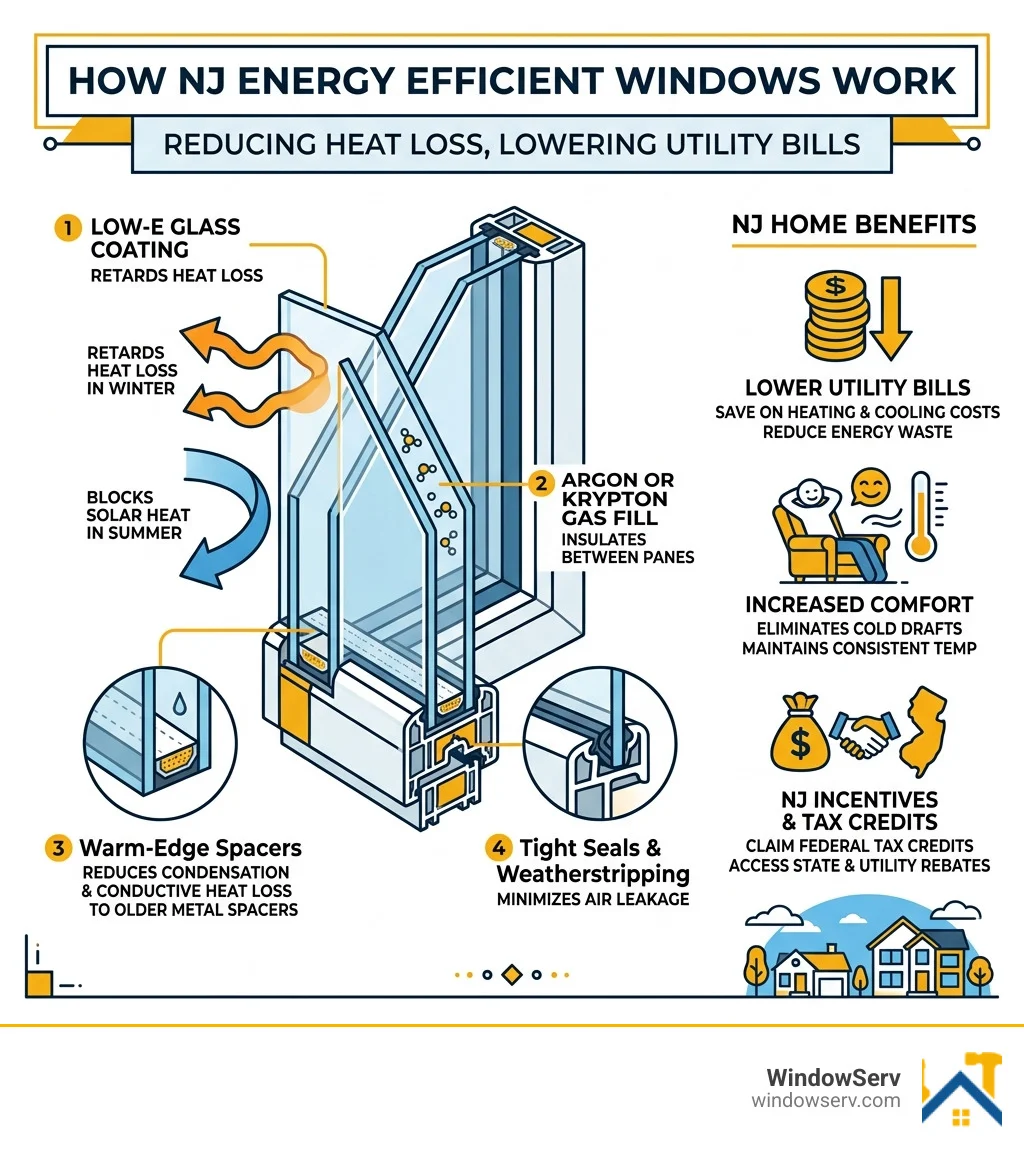
High-performance windows work by addressing four types of energy loss: conduction, radiation, convection, and air leakage. Here are the key features that make this possible:
-
Low-E Coatings: Low-Emissivity (Low-E) coatings are microscopically thin, transparent layers of metal or metallic oxide applied to the glass. They act like a thermos—reflecting interior heat back inside during the winter and bouncing solar heat away during our humid New Jersey summers.
-
Multi-Pane Glazing: Gone are the days of single-pane glass. Double or triple-pane windows create insulating air pockets. While double-glazing is standard and often sufficient for the Mid-Atlantic region, triple-pane glass offers even higher levels of noise reduction and thermal resistance.
-
Gas Fills: The space between those panes isn’t just empty air. We often use inert gases like Argon or Krypton. These gases are denser than air, which significantly slows down heat transfer. Argon is the most common and cost-effective, while Krypton is even more efficient (though often reserved for thinner gaps in triple-pane units).
-
Thermal Breaks and Insulated Frames: A window is only as good as its frame. We prioritize frames made of vinyl, fiberglass, or composite materials that don’t conduct heat like old aluminum frames do. Multi-chambered vinyl frames trap air to create additional layers of insulation.
-
Warm-Edge Spacers: These are the pieces that keep the glass panes at the correct distance. Historically, these were made of aluminum, which was a disaster for energy efficiency because they “conducted” the cold right to the edge of the glass. Modern warm-edge spacers (like Intercept™) use non-metallic materials to keep the edges of the window warm, preventing condensation and adding about 5% to your monthly energy savings.
For a deeper dive into how these components come together, you can check out the NR Energy-Efficient Windows | NJ Green Building Manual or read more info about insulated glass units on our site.
Decoding NFRC Ratings for New Jersey Homes
Shopping for windows without looking at the NFRC (National Fenestration Rating Council) label is like buying a car without checking the MPG. This label provides standardized performance ratings so you can compare “apples to apples.”
Here is what New Jersey homeowners should look for on that sticker:
-
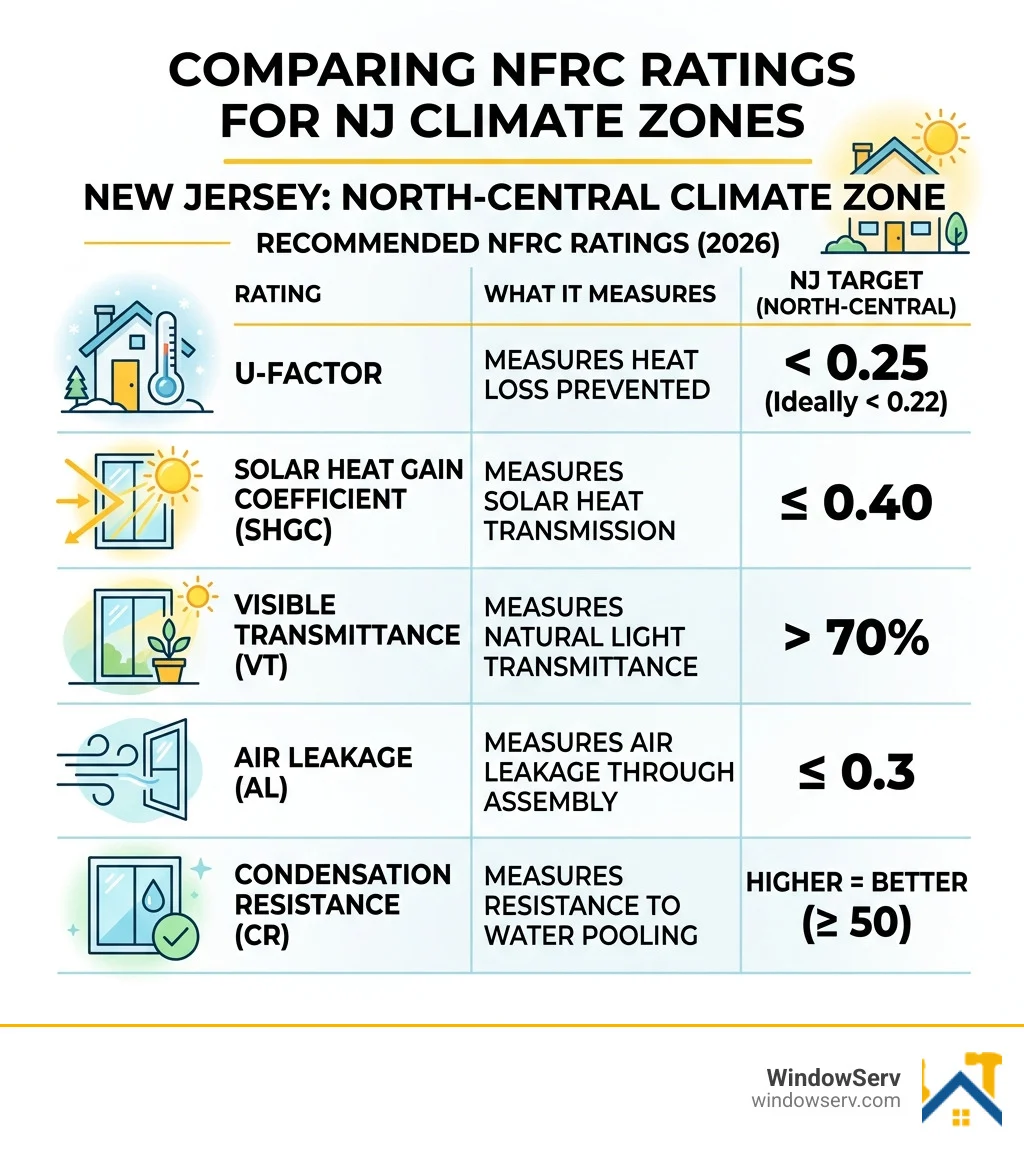
U-Factor: This measures how well the window prevents heat from escaping. The lower the number, the better the window insulates. In NJ, you want a U-Factor of 0.30 or lower (ideally < 0.25).
-
Solar Heat Gain Coefficient (SHGC): This measures how much heat from the sun comes through the glass. In our climate, a SHGC of ≤ 0.40 is recommended. However, if your home has a lot of western-facing windows that get baked in the afternoon, you might want an SHGC as low as 0.25 to save on AC costs.
-
Visible Transmittance (VT): This is how much natural light comes through. A higher number means more light. We usually recommend a VT of > 70% to keep your home bright while still being efficient.
-
Air Leakage (AL): This measures how much air “leaks” through the window assembly. A lower number is better. Look for ≤ 0.3.
-
Condensation Resistance (CR): This measures how well the window resists water pooling on the inside. In NJ’s humid summers and damp winters, a higher CR is better to prevent mold and wood rot.
Selecting the Right NJ Energy Efficient Windows for Your Climate
New Jersey sits in the North-Central climate zone according to ENERGY STAR. This means we experience “all four seasons”—sometimes in the same week! Because of this, our windows have to be versatile.
-
Winter Strategy: We need low U-factors to keep that expensive furnace heat inside.
-
Summer Strategy: We need a balanced SHGC to prevent the “greenhouse effect” from making our living rooms feel like saunas.
-
Orientation Matters: When we help homeowners in Paramus or Summit, we look at the home’s design. South-facing windows might benefit from a slightly higher SHGC to help warm the house in winter (passive solar heating), while north-facing windows should prioritize the lowest possible U-factor.
Maximizing Savings with Federal and State Incentives
Upgrading your windows is a significant investment, but you shouldn’t have to foot the entire bill yourself. Thanks to the Inflation Reduction Act (IRA) and New Jersey’s aggressive clean energy goals, there has never been a better time to buy nj energy efficient windows.
The federal government currently offers the Energy Efficient Home Improvement Credit. This allows you to claim 30% of the cost of qualifying windows and skylights, up to a $600 annual cap. While $600 might not cover the whole project, this credit is part of a larger $1,200 annual limit for general home improvements. If you’re doing a whole-home energy overhaul, you can strategically time your upgrades over several years to maximize these credits.
The best part? These federal credits are stackable with New Jersey state programs. This means you can get your federal tax break and a utility rebate at the same time.
Check out this Project: Energy Efficiency Upgrade to see how these savings look in a real-world NJ home.
NJ Energy Efficient Windows Rebates and Utility Programs
New Jersey is a leader in utility-sponsored energy efficiency. Depending on where you live (Jersey City, Westfield, or Livingston), your utility provider likely has a program to help you.
-
PSE&G Home Weatherization: If you are a PSE&G customer, you may be eligible for a free Home Energy Assessment. They provide an in-home walk-through and can offer no-cost products like LED bulbs and weatherstripping. For larger upgrades like windows, they often offer rebates or 0% financing options (up to $25,000 for some whole-home projects).
-
NJ Clean Energy Program (NJCEP): This state-run program offers various incentives for ENERGY STAR-certified products. They also oversee the Comfort Partners program, which helps low-income families (below 250% of the federal poverty level) with free energy-saving improvements.
-
JCP&L, NJNG, and South Jersey Gas: Most major NJ utilities offer “Pay for Performance” or whole-house rebate programs. If your window replacement is part of a project that reduces your home’s energy use by 20% or more, you could be eligible for thousands of dollars in cash-back rebates.
Required Documentation for Rebates: To ensure you don’t miss out, keep a “rebate folder” with the following:
-
Your itemized sales receipt.
-
The NFRC “stickers” from the windows (don’t throw these away until the rebate is approved!).
-
The manufacturer’s certification statement.
-
Your utility account number.
-
Proof of installation by a licensed NJ contractor.
How to Verify Eligibility and Apply for Incentives
Navigating government forms can be a headache, but the savings are worth it. To qualify for most NJ and federal incentives:
-
Primary Residence: The home must be your primary residence (investment properties usually don’t qualify for the federal credit).
-
ENERGY STAR Certification: The windows must meet the ENERGY STAR version 7.0 requirements for the Northern or North-Central zone.
-
Licensed Contractors: You generally cannot DIY your way to a rebate. Programs like the NJ Clean Energy Program require installation by a licensed and insured New Jersey contractor.
-
Application Deadlines: Many utility rebates must be submitted within 60–90 days of installation. Don’t wait!
Step-by-Step Guide to Upgrading Your Windows for Efficiency
Ready to stop the drafts? Here is our recommended path to success for your NJ home:
Step 1: The Energy Audit Before you buy a single window, get a professional energy audit. A “Blower Door Test” can pinpoint exactly where air is leaking. You might find that your windows are fine, but the frames or the surrounding insulation are the real culprits. Customers can save 5% to 30% on their energy bills just by following the recommendations of an audit.
Step 2: Contractor Selection Don’t just hire the cheapest guy with a truck. Look for contractors who understand nj energy efficient windows and the specific requirements of the NJ Clean Energy Program. We pride ourselves on being local NJ experts who ensure every window is flashed and sealed according to ASTM E 2112 standards—the gold standard for preventing air and water leaks.
Step 3: Choose Your Style Whether you want double-hung windows for a classic Tenafly colonial or sleek casement windows for a modern Hoboken condo, ensure they are ENERGY STAR certified.
Step 4: Professional Installation This is critical. Even the most expensive window will fail if it’s not shimmed, leveled, and insulated correctly. Poor installation can lead to “thermal bridging,” where heat bypasses the window entirely through gaps in the frame.
Explore our Services: Window Replacement and Services: Window Installation pages to see how we handle the process from start to finish.
Bundling Upgrades for Greater ROI
If you’re replacing windows, it’s the perfect time to look at the rest of your home’s envelope. In New Jersey, we often see that “bundling” upgrades leads to much higher rebates.
For example, if you replace your windows and add attic insulation at the same time, you may qualify for the HOMES Rebate program, which offers up to $8,000 for projects that achieve significant energy savings. Improving your insulation ensures that the heat your new windows are keeping inside doesn’t just escape through the roof.
Check out our Energy Efficiency Insulation Tips for Homeowners or see a recent Project: Heat Insulation Upgrade for inspiration.
Common Mistakes to Avoid During Replacement
We’ve seen it all, and we want to help you avoid these common pitfalls:
-
Buying “Cheap” Windows: A $200 window from a big-box store often lacks the gas fills and Low-E coatings required to actually save you money. You’ll pay more in the long run.
-
Ignoring Air Leakage: Replacing the glass but leaving a drafty, uninsulated frame is like putting a high-tech door on a tent.
-
Missing Deadlines: Rebate programs are often “first-come, first-served.” If the state fund runs out in October, you might be out of luck until the next fiscal year.
-
DIY Installation: Aside from potentially voiding your warranty, DIY installation usually makes you ineligible for state and federal rebates that require a licensed professional.
Frequently Asked Questions about NJ Window Replacements
How much can I save on my energy bills in NJ?
On average, New Jersey homeowners save about 12% to 33% on their heating and cooling costs after switching to high-performance windows. According to ENERGY STAR, upgrading from single-pane windows to certified replacements in the Mid-Atlantic saves an average of $236 per year. Over the lifespan of the windows, they often pay for themselves entirely. You can see a breakdown of a similar project here: Project: Energy Efficient Windows.
What is the average cost of energy-efficient windows in NJ?
The national average for window installation is around $5,040, but in New Jersey, most homeowners spend between $2,584 and $7,497 depending on the number of windows and the materials chosen. While the upfront cost is higher than standard windows, the 30% federal tax credit and state rebates can knock thousands off the total price, while the increased resale value of your home adds long-term equity.
Why is professional installation necessary for rebates?
State and federal agencies want to ensure the energy savings they are “paying for” actually happen. Licensed contractors are required to provide proof of insurance, follow building codes, and provide the specific documentation (like the NFRC labels) required for the rebate application. Plus, a professional installation includes air sealing and flashing that a typical DIYer might miss, ensuring your 30% energy savings actually materialize.
Conclusion
Upgrading to nj energy efficient windows is one of the smartest moves you can make for your home. Not only do you get to enjoy a quieter, more comfortable house in the face of Jersey’s wild weather, but you also take a huge bite out of your monthly utility bills.
At WindowServ, we specialize in comprehensive solutions for New Jersey homeowners. Whether you need a full replacement in Paramus or a frame restoration in Cresskill, our local experts are here to help. We focus on maximizing your energy efficiency—often achieving up to 30% energy savings—while offering a satisfaction guarantee that gives you peace of mind.
Don’t let your hard-earned money leak out of your old windows for another season. Between the 30% federal tax credit and the stackable NJ utility rebates, the time to act is now.
Schedule your window repair or replacement today and start saving!