
What It Really Means to Replace a Sealed Glass Unit Replacing a sealed glass unit is the process of swapping out the insulated glass panel inside your existing window frame
What It Really Means to Replace a Sealed Glass Unit
Replacing a sealed glass unit is the process of swapping out the insulated glass panel inside your existing window frame — without touching the frame itself. Here is a quick overview of what that involves:
-
Identify the problem — foggy glass, condensation between panes, or a cracked unit
-
Measure the existing unit — width, height, and thickness to the nearest 1/16 inch
-
Order a custom replacement IGU — typically ready in 2 to 10 business days
-
Remove the old unit — pry out glazing beads, lift out the failed glass
-
Install the new unit — set on rubber blocks, seal with silicone, reinstall beads
-
Allow to cure — 24 to 48 hours before the window is fully weathertight
This approach costs 50% to 70% less than replacing the entire window — and in most cases, it’s all you need.
That foggy view through your window is not just an eyesore. It is a sign that the hermetic seal inside your double-pane unit has failed, letting moist air creep between the glass panes and rob your home of its insulation. For busy New Jersey homeowners, this kind of slow, silent energy drain can push heating and cooling bills noticeably higher — all while the window looks like it should still be working fine.
The good news? You almost certainly do not need to replace the entire window. The glass unit itself is a modular component, and in most cases it can be replaced cleanly and affordably on its own.
I’m Feiruz Gabibov, Chief Operating Officer of WindowServ, where I’ve overseen hundreds of projects to replace sealed glass units across New Jersey homes — from older wood-frame houses to modern vinyl-clad windows. In that role, I’ve seen how the right repair at the right time can restore a window’s performance, clarity, and energy efficiency without the cost of a full replacement.

Understanding the Anatomy of an Insulated Glass Unit (IGU)
To understand why you need to replace sealed glass unit components when they fail, you first have to understand what’s going on inside that “sandwich” of glass. An Insulated Glass Unit (IGU) is much more than just two sheets of glass. It is a precision-engineered environment designed to slow down the transfer of heat.
Modern IGUs consist of two or three panes of glass separated by a spacer bar. This spacer creates a gap that is filled with either air or, more commonly in high-performance windows, an inert gas like Argon or Krypton. Argon gas is a popular choice because it is 30% more efficient at insulating than plain air, while Krypton can offer up to a 40% improvement, especially in thinner units.
Inside that spacer bar, you’ll find desiccant beads. These act like those little “do not eat” silica packets you find in shoeboxes; they absorb any residual moisture that might be present during manufacturing. The entire unit is then protected by a hermetic seal—usually a primary seal of polyisobutylene and a secondary outer seal—to keep the gas in and the moisture out.
When this system works, it’s incredible. The thermal conductivity of insulated glass is 27 times better than standard single-pane glass, and it can cut outside noise by 27 to 50 decibels. But when that seal breaks, the unit loses its “superpowers,” and that’s when it’s time to look into How to Replace a Double Pane Window Glass Unit – Engineer Fix.
When to Replace a Sealed Glass Unit
IGUs are built to last, with many units serving homeowners for 20 to 25 years. However, New Jersey’s climate—with its humid summers and freezing winters—puts immense pressure on these seals. Repeated freeze-and-thaw cycles cause the glass and frames to expand and contract, a process known as “solar pumping,” which can eventually cause the seal to hairline-fracture.
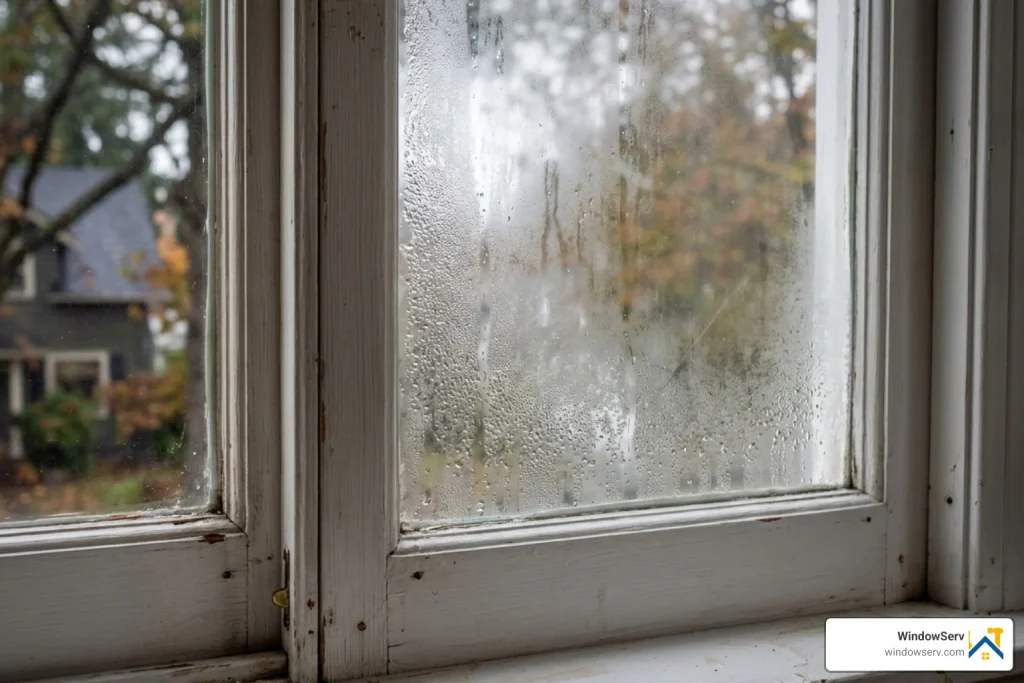
Once the seal is compromised, you’ll notice fogging or internal condensation. This isn’t just a cosmetic issue; it’s a sign that your window is no longer insulating your home. You might also see calcium deposits (white streaks) forming inside the glass, which are permanent mineral stains left behind by evaporated moisture.
Signs You Need to Replace Sealed Glass Unit
Keep an eye out for these red flags:
-
Visual Distortion: If the glass looks like a “funhouse mirror” or seems to be bowing inward, the pressure balance has failed.
-
Rising Energy Bills: If your heating or cooling costs have spiked by 15% to 20% without a clear reason, your window seals may be the culprit.
-
Drafts: Feeling a chill even when the window is locked usually points to a failed IGU.
-
Moisture Infiltration: Seeing water droplets inside the two panes that you can’t wipe away.
To get a better idea of the financial side of this repair, check out our guide on Window Seal Replacement Cost.
Choosing Between Glass Repair and Full Frame Replacement
One of the most common questions we get at WindowServ is: “Do I need a whole new window?” The answer depends entirely on the condition of your frames.
If your window frames are structurally sound—meaning no major Wooden Window Refurbishment is needed and there is no significant rot or warping—then you should definitely replace sealed glass unit parts only. This typically runs between $150 to $500 per window, whereas a full replacement can cost anywhere from $400 to $1,200.
Feature Glass-Only Replacement Full Window Replacement Cost 50% – 70% Less Full Market Price Installation Time 1 – 2 Hours 4 – 8 Hours Mess/Debris Minimal Significant (Siding/Trim impact) Aesthetics Keeps original frame Changes look of the home
Measuring and Ordering Your Custom Replacement Unit
Precision is everything when you decide to replace sealed glass unit panels. Because these units are hermetically sealed at the factory, they cannot be cut or adjusted once they arrive. If your measurement is off by even 1/8 of an inch, the unit might not fit into the sash channel.
To get an accurate order for Insulated Glass Units, you need three key measurements:
-
Width: Measure at the top, middle, and bottom. Use the smallest of the three.
-
Height: Measure at the left, center, and right. Use the smallest of the three.
-
Thickness: This is the “depth” of the entire sandwich (e.g., 1/2″, 5/8″, or 1″).
Pro Tip: Always deduct 1/8 inch (3 mm) from your final width and height measurements. This provides a necessary expansion gap for the glass to move slightly as temperatures change without cracking.
When ordering, you can also choose to upgrade your glass. Many of our New Jersey clients opt for Low-E coatings, which feature a microscopic metallic layer that reflects infrared heat—keeping you warmer in the winter and cooler in the summer. If the window is near a door or low to the ground, you may be required by local building codes to use tempered glass, which crumbles into safe pebbles if broken.
The Step-by-Step Process to Replace Sealed Glass Unit
If you are a handy DIYer, you can certainly tackle this project, though we always recommend a professional touch for larger windows or high-up second stories. The goal is to remove the failed unit and seat the new one perfectly to ensure a long-lasting seal.

Preparation and Safety Protocols
Safety isn’t just a suggestion when handling glass; it’s a requirement. Before starting, clear the area of children and pets.
-
Stabilize the Glass: If the unit is already cracked, apply duct tape in an “X” pattern over the cracks to prevent shards from falling out.
-
Gear Up: Wear safety goggles, heavy-duty leather gloves, and—highly recommended—Kevlar arm guards to protect against accidental slips.
-
Clear the Workspace: Ensure you have a flat, stable area to work on if you are removing the entire sash.
For more information on the tools involved, see our Window Glass Replacement service page.
Professional Tips to Replace Sealed Glass Unit
Once the old unit is out, the frame must be cleaned thoroughly. Any old sealant, dirt, or debris left in the channel will prevent the new unit from sealing correctly, which is the number one cause of premature failure in DIY jobs.
-
Use Setting Blocks: Place rubber or plastic setting blocks at the bottom of the frame. These support the heavy glass and keep it centered so it doesn’t rest directly on the frame, which could cause a stress crack.
-
Apply Sealant: Use a high-quality, neutral-cure silicone. Unlike standard caulk, neutral-cure silicone won’t react with the secondary seal of the IGU.
-
Pressure Equalization: If you are ordering glass from a different altitude, ensure it has capillary tubes. These small tubes allow the unit to “breathe” during transit so it doesn’t explode or implode due to pressure changes. These must be sealed with silicone once the unit is at its final destination.
-
The Smoke Test: After the sealant has cured for 24 hours, you can check for air leaks by passing a stick of incense near the edges. If the smoke dances, you have a gap that needs more sealant.
Frequently Asked Questions about Sealed Units
Can I replace just one pane of a double-pane unit?
No. This is a common myth. Because an IGU is a factory-sealed environment filled with specific gases and desiccants, you cannot simply “pop out” one sheet of glass. Attempting to do so destroys the hermetic seal instantly. To restore the window’s performance, you must replace the entire sealed unit.
How long does it take to replace a sealed glass unit?
The actual installation typically takes a professional about 1 to 2 hours per window. However, keep in mind the lead times. Because every unit is custom-made to your specific dimensions, production time usually ranges from 2 to 10 business days.
Will replacing the glass unit void my window warranty?
This depends on your original window manufacturer. Some companies require professional installation to maintain the warranty on the frame itself. However, most new replacement IGUs come with their own 10-year limited warranty against seal failure, giving you peace of mind for the decade to come.
Conclusion
At WindowServ, we believe in providing New Jersey homeowners with the smartest, most cost-effective solutions for their homes. Whether you are in Jersey City, Ridgewood, or anywhere in Bergen, Essex, or Monmouth counties, our team is ready to help you restore your view.
By choosing to replace sealed glass unit panels instead of the whole window, you can save thousands of dollars while still achieving up to 30% energy savings. We stand by our work with a satisfaction guarantee and the local expertise you expect from a neighbor.
Stop staring at those foggy streaks and start enjoying the view again. For a clear solution to your window woes, check out our window repair services or contact us today for a free estimate.