

Why sound proof window glass Matters More Than You Think Quick answer: What is soundproof window glass? Feature What It Means for You Laminated glass with acoustic interlayer Absorbs sound
Why sound proof window glass Matters More Than You Think
Quick answer: What is soundproof window glass?
Feature What It Means for You Laminated glass with acoustic interlayer Absorbs sound vibrations instead of passing them through Multiple panes with air gaps Creates barriers that slow sound wave transfer Higher STC/OITC ratings Measurably less noise reaching your living space Professional sealing and installation Prevents sound from leaking around the frame
Living near a busy New Jersey road, highway, or rail line means noise is a constant presence — not just an occasional annoyance. Roadway rumble, aircraft overhead, and neighborhood sounds don’t stop because you’ve closed your windows. And if your home has older or standard single-pane windows, most of that noise is traveling straight through the glass with very little resistance.
The problem is real. Noise levels above 70 dB over prolonged periods can begin to damage hearing, and everyday urban sound sources — including heavy street noise and construction — regularly hit or exceed that threshold. Even below that level, chronic noise exposure causes stress, disrupts sleep, and reduces quality of life.
That’s where sound proof window glass comes in. Unlike standard glass, which simply sits as a single rigid sheet and transmits sound vibrations almost unimpeded, acoustic glass is engineered specifically to interrupt, absorb, and dampen those vibrations before they reach your ears.
I’m Feiruz Gabibov, Chief Operating Officer of WindowServ, and over the years I’ve helped hundreds of New Jersey homeowners evaluate and install sound proof window glass solutions — from simple frame upgrades to full acoustic glazing replacements. In the sections below, I’ll walk you through exactly how this technology works, what the ratings mean, and how to choose the right option for your home.
What is Sound Proof Window Glass and How Does It Work?
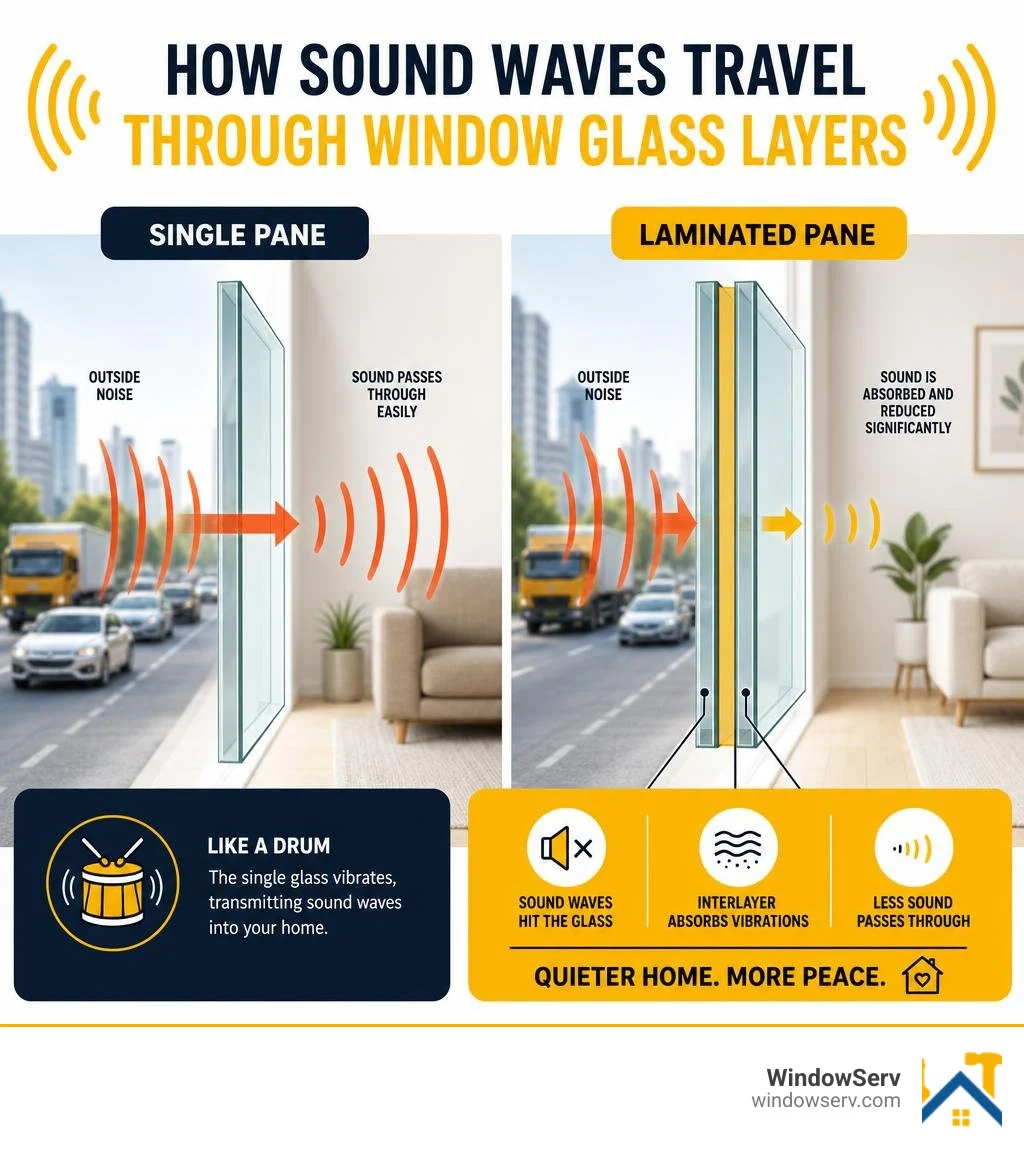
To understand how sound proof window glass works, we first have to look at how sound itself behaves. Sound is not an invisible, ghostly presence; it is a physical force. It travels in pressure waves through the air, looking for any medium to vibrate. When those waves hit a standard window pane, they cause the rigid glass to vibrate like a drumhead. That vibration then compresses the air inside your home, recreating the sound wave on the other side.
Standard window glass is thin, stiff, and lightweight, making it an excellent transmitter of sound. Acoustic glass, on the other hand, is specifically engineered to disrupt this pathway. It uses three core principles of acoustic physics to block out the noise:
-
Mass: Thicker, heavier glass blocks more sound because it takes more energy for a sound wave to vibrate a heavy object than a light one.
-
Damping: By introducing flexible materials into the glass structure, we can absorb the energy of the sound wave and convert it into trace amounts of heat, stopping the vibration in its tracks.
-
Decoupling: Separating glass panes with air or gas buffers breaks the physical path that sound waves travel through.
The Science of Sound Proof Window Glass vs. Standard Glass
Standard single-pane windows typically feature a single sheet of monolithic annealed glass, usually about 3mm thick. Because this glass is uniform and rigid, it has a specific “resonance frequency” or coincidence frequency. This is the exact pitch or frequency at which the glass naturally wants to vibrate. When outdoor noise matches this frequency, the glass transmits the sound with almost zero resistance.
Acoustic glass prevents this resonance by combining different materials. By sandwiching a soft polymer plastic layer between sheets of glass, we create a composite material that does not have a single resonance frequency. When sound waves hit this barrier, the soft inner layer acts as a shock absorber. This process, known as shear damping, significantly reduces the vibration of the glass.
If you are tired of your windows acting like speakers for the neighborhood, you can Learn more about noise reduction glazing and how specialized glass retrofits can restore peace to your home.
Understanding STC and OITC Ratings for Sound Proof Window Glass
When comparing acoustic windows, you will encounter two primary industry standards: STC and OITC. Understanding these ratings is crucial to making an informed investment.
-
STC (Sound Transmission Class): This rating measures a material’s ability to block mid-to-high-frequency sounds (ranging from 125 Hz to 4,000 Hz). This range covers common indoor noises like human speech, television audio, barking dogs, and office equipment. STC is the most common rating you will see on residential windows.
-
OITC (Outdoor-Indoor Transmission Class): This is a newer, more rigorous standard that measures sound transmission across a lower frequency range (80 Hz to 4,000 Hz). Low-frequency sounds include the heavy rumble of highway noise, low-flying aircraft, railway trains, and industrial machinery.
For both ratings, a higher number indicates better sound-blocking performance. However, because the decibel scale is logarithmic, the difference between numbers is far greater than it looks on paper.
For example, a standard single-pane window has an STC rating of about 26. An upgraded acoustic window might have an STC rating of 36. That 10-point increase represents a 50% perceived reduction in noise inside your home. If you step up to high-performance configurations with ratings of STC 45 or higher, you can reduce incoming noise levels by 75% to 95%, turning a noisy street into a quiet library.
Key Technologies and Glazing Configurations for Noise Reduction
No single piece of glass can solve every noise problem. Achieving true acoustic comfort requires combining different technologies, glass thicknesses, and spacing configurations.
Laminated Glass and the Role of the Acoustic Interlayer
The single most effective weapon in the fight against noise is laminated glass. Laminated glass is made by bonding two or more panes of glass together under heat and pressure with a thin, clear plastic interlayer.
While standard laminated glass often uses a basic Polyvinyl Butyral (PVB) film primarily for safety and impact resistance, true sound proof window glass utilizes a specialized acoustic PVB interlayer. This acoustic interlayer is specifically formulated to be softer and more elastic than standard plastic films.
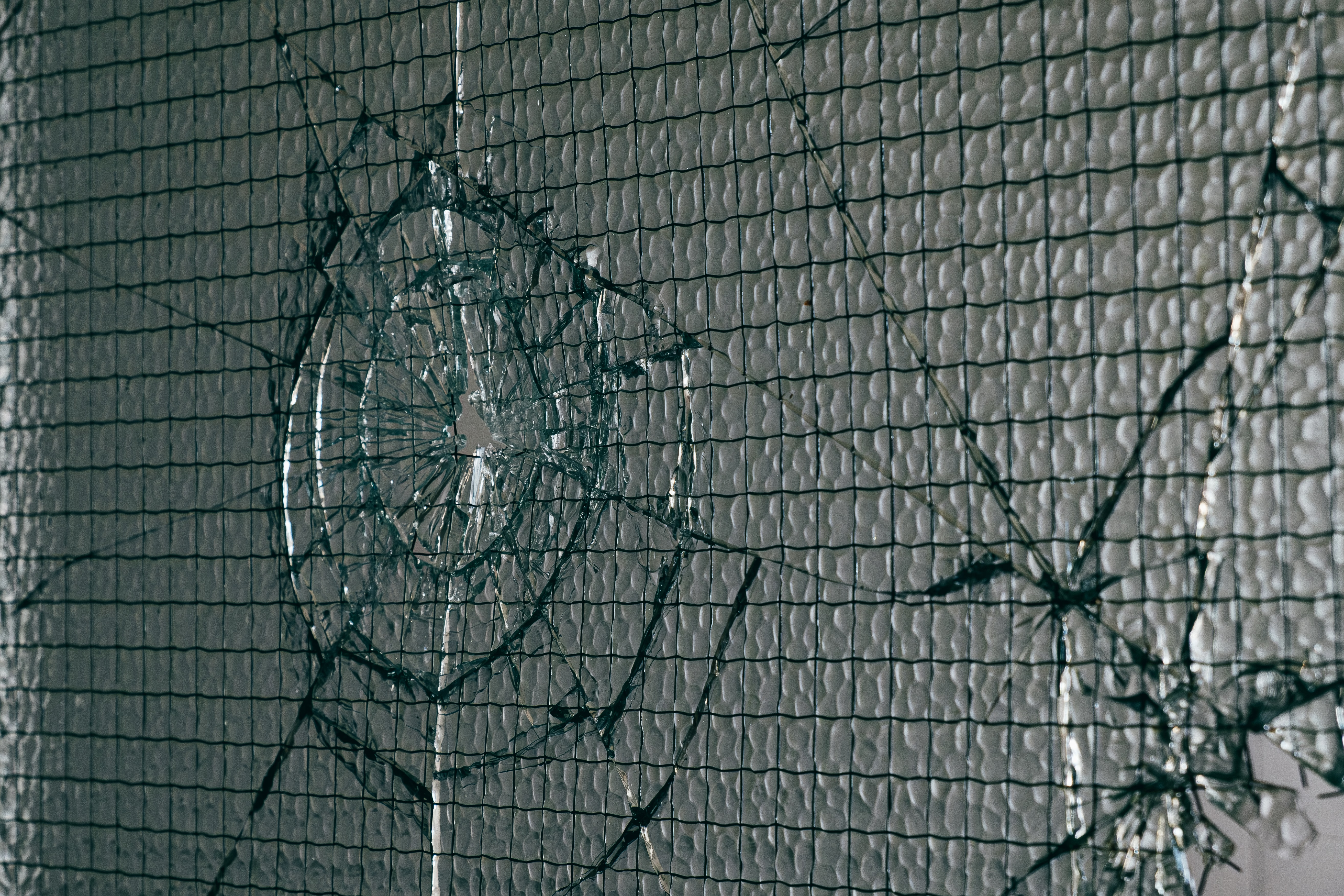
When a sound wave hits the outer pane of glass, the energy travels to the acoustic PVB interlayer. Because the interlayer is flexible, it undergoes shear deformation, absorbing the sound wave’s energy and dissipating it as microscopic thermal energy. High-quality products like Pilkington Optiphon™ utilize this exact technology to provide exceptional sound attenuation without compromising on light transmission or safety.
If your current double-pane windows are letting in too much noise, we can often replace the glass units themselves with acoustic laminated options. Explore acoustic laminated glass options to see how this simple swap can transform your space.
Asymmetric Glass Thickness and Air Space Optimization
If you install a double-pane window where both panes of glass are the exact same thickness (for example, two sheets of standard 3mm glass), they will share the exact same coincidence frequency. This means they will both vibrate in perfect harmony when exposed to certain outdoor pitches, allowing the noise to pass straight through.
To prevent this, acoustic engineers use asymmetric glass thickness. By pairing a 3mm pane of glass with a 5mm or 6mm pane of glass in the same Insulated Glass Unit (IGU), we ensure that each pane targets and dampens different sound frequencies. What gets past the first pane is blocked by the second.
Additionally, the air space between the panes plays a major role. In standard double-pane windows, the air gap is relatively small (typically around 1/2 inch or 12mm), which is optimized for thermal insulation but can actually transmit sound vibrations easily. Widening this air gap decouples the two panes of glass further. As a rule of thumb, doubling the air gap between your glass panes can add 2 to 3 points to your window’s overall STC rating.
To see how these principles are applied in real New Jersey homes, you can Discover soundproofing solutions for urban homes.
Comparing Single, Double, Triple, and Vacuum Glazing
Many homeowners assume that adding more panes of glass automatically equals better soundproofing. However, a standard triple-pane window can sometimes perform worse than a double-pane window with laminated glass because the extra thin panes and small air gaps can create internal resonance chambers.
To help you visualize how different glass configurations stack up, here is a comparison of standard industry measurements:
Glass Configuration Typical STC Rating Typical OITC Rating Best Suited For Single Monolithic Annealed (3mm) 26 22 Quiet suburban areas, interior partitions Standard 2-Pane Annealed IGU 31 25 Standard residential homes with moderate noise Single Acoustic Laminated Glass 35 30 Interior office privacy, secondary glazing 2-Pane Asymmetric IGU (with 1 Laminated Pane) 38 32 Homes near busy local roads and urban centers 3-Pane Lami IGU (with multiple laminated panes) 43 35 Homes near highways, airports, or train tracks Vacuum Insulated Glazing (VIG) 36 – 39 31 – 34 Historic retrofits, ultra-slim high-performance needs
In recent years, third-generation Vacuum Insulated Glazing (VIG) technologies, such as PassivGlas™ Linear – PassivGlas and Landvac Soundproof Noise Reduction 8.3mm Thin Window Door Tempered Vacuum Window Glass – MadeInChina.com , have emerged as game-changers. Because sound waves require a physical medium (like air or gas) to travel, a vacuum layer completely eliminates gas heat and sound transfer. An ultra-thin 8.3mm VIG unit can deliver sound reduction performance that rivals thick, heavy triple-pane units, making it an excellent option for historic home retrofits where slim profiles are required.
If you are planning to upgrade your home’s exterior, you can Read about quiet replacement windows in NJ or Check out energy-efficient vacuum insulating glass technology to find the perfect balance of thermal efficiency and acoustic performance.
Upgrading Existing Windows vs. Full Replacement
When dealing with noisy windows, you don’t always have to tear out your entire window frame. Depending on the condition of your existing frames, you have a few different paths to choose from.
Secondary Glazing and Window Inserts
For homeowners in historic districts like Montclair, Ridgewood, or Tenafly, replacing original wood window frames is often restricted or undesirable. In these cases, secondary glazing or window inserts are an outstanding alternative.
This method involves installing a secondary, fully functional acoustic window on the interior side of your existing window frame.
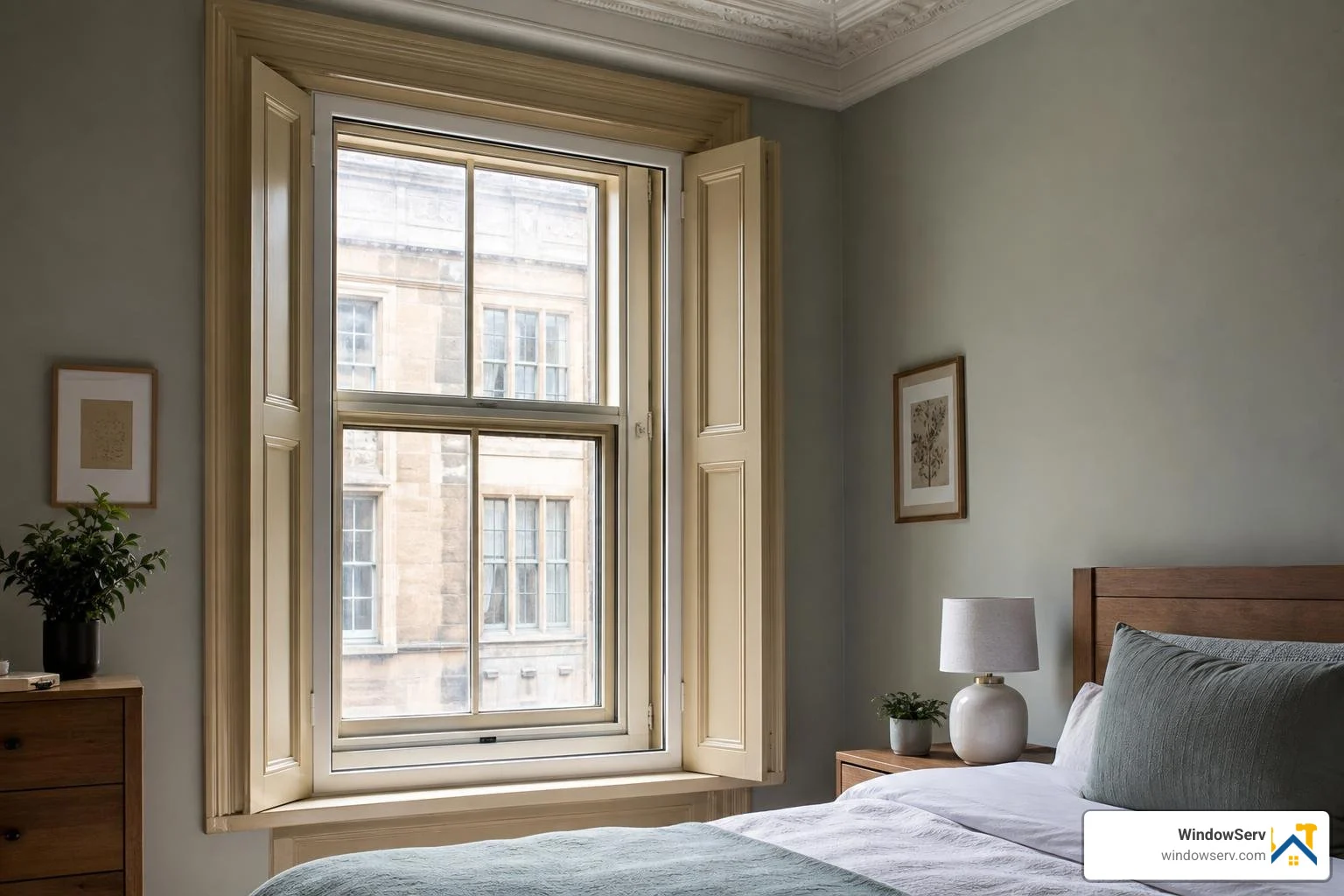
This configuration creates a massive air gap (often 2 to 4 inches) between the original glass and the new acoustic glass. Because the original window and the secondary insert are completely decoupled, this setup can reduce incoming noise by up to 80% to 90%, while also cutting down on drafts and energy bills.
To learn more about how this non-invasive approach works, you can Learn about soundproof secondary glazing.
Sealing, Repairing, and Retrofitting Existing Frames
Sometimes, the noise isn’t coming through the glass itself, but around it. Sound behaves like water; if there is even a microscopic gap in your window’s seals, sound waves will pour right through. A single unsealed gap can reduce a window’s effective sound isolation by up to 5 dB.
Before spending money on new glass, it is essential to inspect your window seals, weatherstripping, and frames. If you notice drafts, rattling, or visible gaps, applying high-quality acoustic sealant and replacing worn-out weatherstripping can make a noticeable difference.
Additionally, if you have older double-pane windows that have failed — resulting in condensation or “foggy” glass — replacing the glass unit is the perfect time to upgrade to acoustic glass. We can install a new, custom-sized asymmetric or laminated IGU directly into your existing frame, saving you the cost of a full window replacement.
If you are dealing with drafty or compromised windows, you can Find out about window glass replacement services and Understand window seal replacement costs to see how easy it is to restore your home’s quiet comfort.
Frequently Asked Questions about Soundproofing Glass
Can soundproof window glass block 100% of outside noise?
No window can block 100% of outside noise. While high-performance acoustic glass systems can reduce noise by up to 95%, some sound will always find a path into your home. This is known as “flanking noise,” where sound vibrations travel through your home’s siding, wall insulation, roof, or ventilation ducts rather than the window itself. However, upgrading to acoustic glass will reduce the noise to a faint, non-disruptive background whisper.
Does soundproof glass also improve energy efficiency?
Yes, absolutely! The same technologies that block sound waves are highly effective at blocking heat transfer. Laminated glass units provide excellent thermal insulation and block up to 99% of harmful UV rays, protecting your furniture and flooring from fading. When paired with low-emissivity (Low-E) coatings and argon gas fills, acoustic windows can lower your heating and cooling costs by up to 30%. You can See our NJ energy efficient windows guide to explore how these technologies work hand-in-hand.
Is professional installation necessary for soundproof windows?
Yes. Because sound travels through the smallest air gaps, even the most expensive acoustic glass will fail to perform if it is not installed with absolute precision. Professional installers use specialized acoustic sealants, ensure the frame is perfectly square and level, and install airtight weatherstripping. At WindowServ, our local New Jersey technicians are trained to eliminate sound leaks, ensuring you get the full acoustic and thermal benefits of your investment.
Conclusion
A quiet home is not a luxury; it is essential for your health, focus, and peace of mind. Whether you are dealing with the constant hum of street noise in Jersey City, train noise in Hoboken, or neighborhood racket in Paramus, upgrading to sound proof window glass is one of the most impactful home improvements you can make.
At WindowServ, we are proud to be New Jersey’s local window experts. We serve Bergen, Essex, Hudson, Middlesex, Monmouth, and Union counties, providing comprehensive repair, restoration, and replacement solutions. We specialize in preserving your home’s original frames while upgrading the glass to deliver up to 30% energy savings and unmatched sound reduction. Backed by our satisfaction guarantee, we are here to help you design a quieter, more comfortable home.
Ready to block out the noise for good? Get professional window soundproofing services from the team at WindowServ today.