

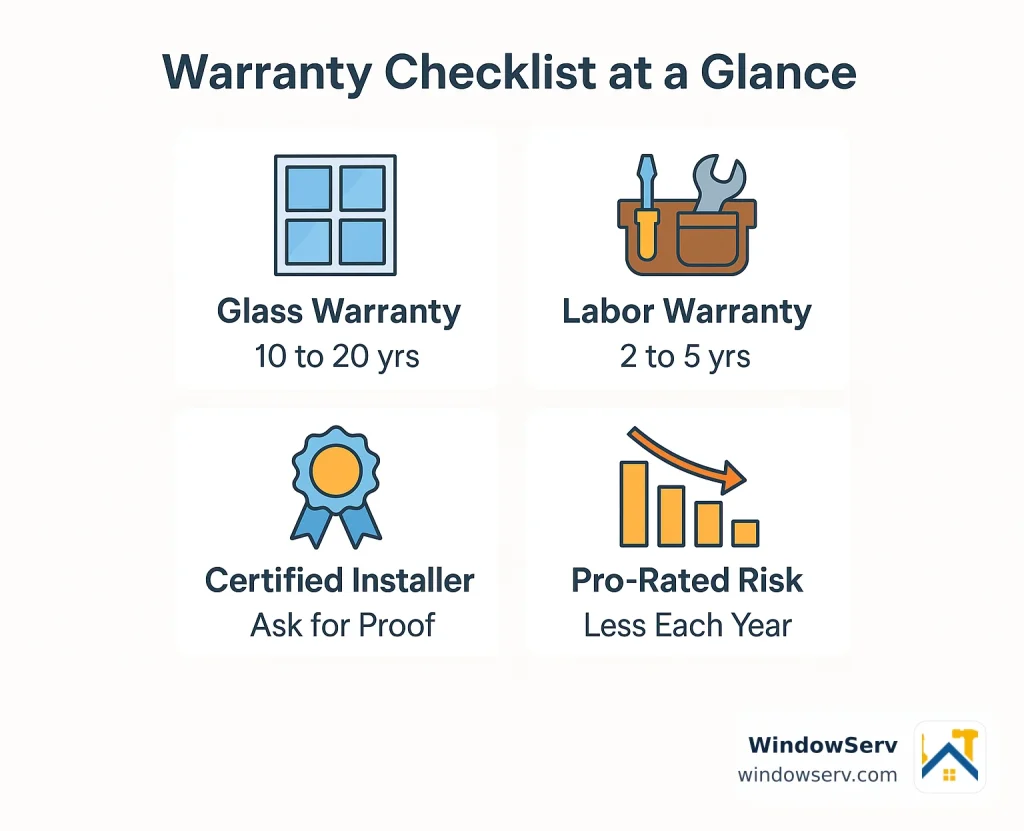
Glass warranties often run 10 to 20 years, but labor warranties can drop to 2 years or less unless your installer is factory-certified — here's what to verify first.
Don’t Let a Warranty Surprise You After Installation
New windows should pay off for decades, but only if the paperwork behind them actually protects you. This checklist breaks down manufacturer coverage, labor warranties, and the pro-rated clauses that quietly shrink your payout year by year. Request a quote and we’ll walk you through every line of your warranty before you sign anything.
Most homeowners assume a “warranty” is a single document. In practice, every replacement project carries at least two separate warranties that rarely expire at the same time or cover the same failures, and knowing the difference before you sign is the single biggest factor in whether a future problem gets fixed for free or billed to you.
Factory-Certified Installers, Not Just Licensed Ones
A general contracting license lets a crew legally install windows. It does not mean the manufacturer stands behind their work. Brands like Andersen, Pella, Marvin, and ProVia only extend their strongest labor and installation warranties to crews who’ve completed the brand’s own certification program and keep that status current through annual recertification. Our installers hold active certification with the major residential brands we carry, which means the manufacturer’s labor coverage actually applies to our work rather than defaulting to a shorter, generic installer warranty. Every window installation we quote lists which certifications apply to that specific product line, so you’re not left guessing after the fact.
Our Own Craftsmanship Warranty Stacked on Top
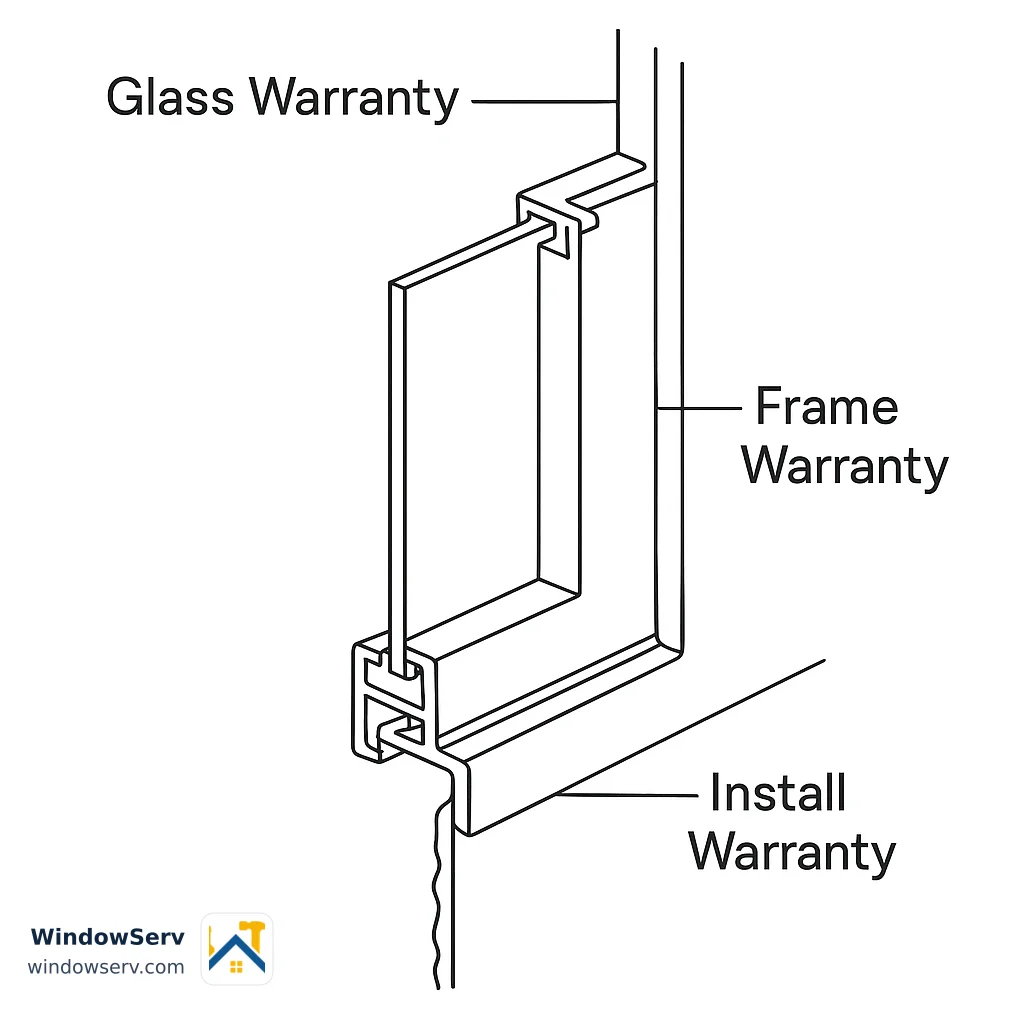
Manufacturer coverage protects the glass unit and frame against defects. It typically does not cover installation mistakes — a window that was never the right size, hung slightly out of square, or sealed with the wrong flashing sequence. That gap is why we back every project with our own non-prorated craftsmanship warranty on labor, separate from and in addition to whatever the manufacturer provides. If a window leaks, sticks, or settles because of how it was installed rather than how it was built, that’s on us, full stop, for the length of our stated term — not a declining percentage.

Paperwork Handed to You the Same Day
A surprising number of warranty disputes come down to missing registration. Many manufacturers require the installer to register the product within a set window after installation, or the full-term coverage quietly reverts to a shorter default period. We complete that registration before we leave the job site and hand you a physical binder with the product serial numbers, the registered warranty certificate, and our own labor warranty terms printed together. You’re never left trying to reconstruct paperwork six years later from a box you threw away.
Experience Across Standard Replacement and New Construction
Not every project is a simple swap of an existing frame. Basement egress installations, for example, involve structural cutting, permitting, and grading work that standard replacement jobs never touch, and the warranty questions change accordingly — what’s covered if the surrounding foundation work settles, versus what’s covered on the window unit itself. We’ve documented that process in detail in Egress Window Installation Timeline Week by Week, because homeowners planning that kind of project deserve to know where manufacturer coverage ends and contractor responsibility begins before the crew ever shows up.
Installation Quality That Protects the Glass Warranty Itself
Here’s a detail most quotes never mention: poor flashing or an improperly shimmed frame can cause a sealed glass unit to fail prematurely, and that failure often gets misdiagnosed as a product defect rather than an installation problem. We flash and seal every opening to manufacturer spec specifically because a seal failure traced back to installation error can void the very glass warranty you were counting on. If you’re ever troubleshooting fogging or seal failure down the road, our breakdown in X Questions to Ask Before Hiring a Window Glass Repair – WindowServ walks through how to tell whether you’re looking at a covered manufacturer defect or a separate repair issue entirely.
Transparent, Line-Item Quotes
Our estimates separate the cost of the window unit, the labor, and any structural or trim work into distinct lines, with the applicable warranty term noted next to each one. You’ll never receive a single bundled number with “warranty included” as the only explanation. We’d rather you compare that level of detail against any other quote you’re considering than take our word for it.
Choosing the right contractor matters as much as choosing the right window. A beautiful quote is worthless if the company behind it can’t honor the warranty terms printed on it a few years from now.
Confirm the Basics First
Before discussing warranty terms at all, verify that the contractor holds an active state contractor license in good standing, carries general liability insurance and workers’ compensation, and can provide at least three references from installation jobs completed in the past two years, not just general remodeling work. Ask to see the license number directly, not just a logo on a truck, and look it up yourself through your state’s licensing board rather than taking the salesperson’s word for it.
Manufacturer Warranty vs Labor Warranty
| What It Typically Covers | Typical Length | Who Honors a Claim | |
|---|---|---|---|
| Manufacturer warranty | Glass seal, frame material, hardware defects | 10 to 20 years, sometimes limited lifetime on glass | The window brand, often routed through the installer |
| Labor/installation warranty | Installer workmanship, flashing, sealing, fit | 2 to 5 years, sometimes non-existent on budget quotes | The contracting company directly |
Notice that these two numbers almost never match. A 20-year glass warranty paired with a 1-year labor warranty means that if a window leaks around the frame in year three, the manufacturer may deny the claim entirely since the failure is installation-related, and your labor coverage has already expired.
Spotting a Pro-Rated Trap
Pro-rated coverage sounds like protection but shrinks fast. A “lifetime” warranty that’s pro-rated after year five might only cover 50 percent of replacement cost by year ten and far less after that, with you paying the difference plus a service call fee. Ask directly whether the warranty is full coverage for its full term or pro-rated, and ask for that answer in writing, not verbally at the kitchen table. If a quote won’t specify this clearly, treat it as a red flag rather than an oversight.
Questions to Ask During the Estimate Visit
- Are you currently certified by the manufacturer of the windows you’re quoting me, and can you show proof of that certification?
- Is the labor warranty you’re offering full coverage for its entire term, or does it reduce in value after a certain year?
- What specifically voids the manufacturer’s glass or frame warranty on this installation?
- If a window fails, do I file the claim with you directly, or with the manufacturer myself?
- Will the product be registered with the manufacturer on my behalf, and will I receive written confirmation?
- Does your labor warranty cover callback visits, or only parts replacement?
- What happens to my labor warranty if your company is no longer in business in ten years?
When the Real Problem Isn’t a Full Replacement
Not every window issue calls for wholesale replacement, and a good contractor should tell you that rather than upsell you. Older double-hung windows that have simply lost their balance mechanism, for instance, are often a repair rather than a replacement job, and our guide on Replacing a Sash Cord: The Ultimate DIY Guide to Smooth Windows – WindowServ covers that distinction in detail. Likewise, if drainage around a below-grade opening becomes an issue after a recent egress install, that’s often a grading or window-well fix rather than a warranty claim on the unit itself, which we break down in Stop Egress Window Well Flooding After Installation.
Get Everything in Writing
Before signing, request a written quote that itemizes the product warranty term, the labor warranty term, the registration process, and the exact steps for filing a future claim. Verbal assurances from a salesperson don’t survive a change in staff or ownership. A contractor confident in their work will hand over this documentation without hesitation; one who hedges or rushes you past it is telling you something important about how they’ll handle a claim down the road.
Not sure what your current quote actually covers?
Send it to our team before you sign, and we’ll walk you through the manufacturer terms, labor coverage, and any pro-rated clauses in plain language — free of charge. Call WindowServ or request a written estimate today, and we’ll show you exactly how our certified installation and warranty documentation compares line by line. No pressure, no obligation, just a clear picture of what you’re buying.